Best Fabric for Golf Polo Shirts
Table of Contents
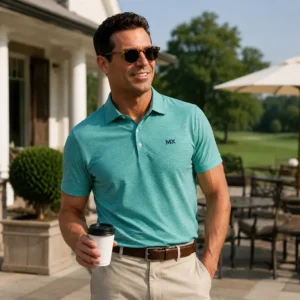
Polyester-spandex is generally the best all-around fabric for golf polo shirts because it combines moisture management, quick drying, stretch, shape recovery, and freedom of movement. Lightweight polyester piqué is another practical option for clubs, tournaments, uniforms, and warm climates, while cotton blends are better when a traditional appearance and natural hand feel matter more than technical performance.
At Mingxingpolo, we select golf polo fabrics according to climate, activity level, target market, design, and price. The best fabric is the one that supports movement while maintaining the appearance your brand requires.
What Does a Golf Polo Fabric Need to Do?
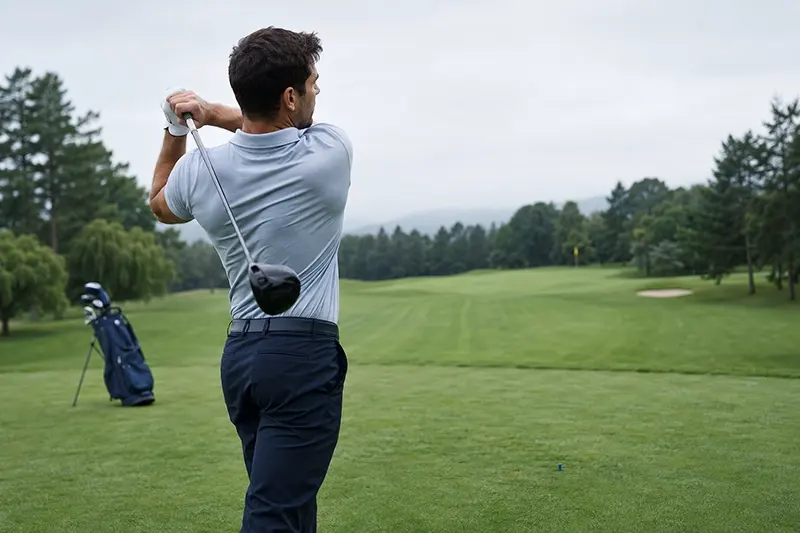
A golf polo must perform differently from a standard casual polo. The wearer may spend several hours outdoors, rotate the upper body repeatedly, and experience changing temperatures throughout the day.
A suitable fabric should provide:
- Breathability
- Moisture management
- Quick drying
- Comfortable stretch
- Reliable shape recovery
- Low garment weight
- Adequate coverage
- Easy care
Appearance is still important. Golf polos are often worn in clubs, resorts, tournaments, and corporate events where the garment needs to look clean and professional.
The challenge is finding a material that supports activity without looking like a basic sports jersey. Fabric texture, sheen, drape, collar construction, and fit all affect the final result.
Polyester-Spandex: The Best All-Around Choice
Polyester-spandex combines the practical performance of polyester with additional flexibility from elastane or spandex.
Polyester absorbs little water and can be developed with moisture-management properties. Spandex allows the fabric to stretch during a swing and recover after movement.
This combination works well for:
- Golf apparel brands
- Professional or amateur teams
- Club uniforms
- Tournament clothing
- Resort staff
- Corporate golf events
- Active lifestyle collections
The fabric can support a clean, athletic silhouette without restricting the shoulders, chest, or arms. It is particularly useful for slim and athletic fits because the material can follow the body while allowing movement.
Stretch percentage should not be considered alone. Buyers should also check recovery. A fabric that stretches easily but does not return to its original dimensions may become loose around the sleeves, chest, or hem.
A custom golf polo shirt made from polyester-spandex should be tested during reaching, rotation, and arm movement before the fit is approved.
Lightweight Polyester Piqué
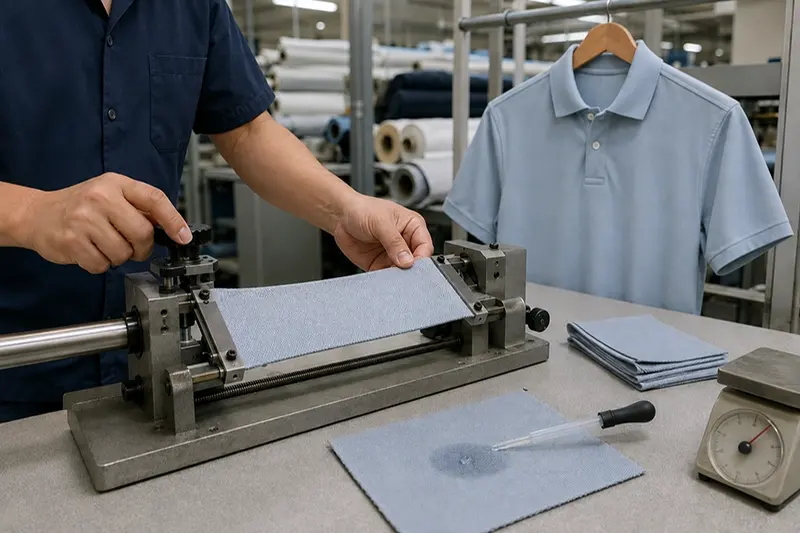
Polyester piqué has a textured surface that creates a more traditional polo appearance than a smooth sports jersey. It is a practical choice when buyers want performance and recognizable polo styling in the same garment.
Its common advantages include:
- Quick-drying performance
- Good color retention
- Low shrinkage
- Easy washing
- Lightweight options
- Stable shape
- Suitable surface for branding
Polyester piqué is widely used for golf clubs, events, resort uniforms, teams, and corporate programs. It can look professional when combined with a structured collar, clean placket, balanced fit, and subtle logo.
Fabric quality is important. Basic polyester may feel rough or look too shiny. A better option will have a softer hand feel, controlled sheen, consistent texture, and sufficient breathability.
Buyers should also check snag resistance because some lightweight knitted polyester fabrics can catch on rough surfaces.
Moisture-Wicking Polyester
Moisture-wicking polyester is designed to move perspiration from the skin toward the outer surface of the fabric, where it can evaporate more efficiently.
This does not mean every polyester fabric automatically provides the same performance. Results depend on the yarn, knitting structure, and finishing.
A suitable moisture-wicking fabric is useful for:
- Hot and humid climates
- Long outdoor golf sessions
- Tournament staff
- Summer collections
- Active corporate teams
The fabric should be tested for more than drying speed. Buyers should also evaluate how it feels when damp, whether it becomes transparent, and whether the performance remains after repeated washing.
Moisture management works best when combined with breathable construction and a suitable fit. An overly tight garment or dense fabric can still feel uncomfortable even when it has a performance finish.
Polyester Mesh for Extra Ventilation
Polyester mesh uses a more open knitted structure to improve airflow. It may be used for the entire polo or applied to selected areas such as the back, underarms, side panels, or inner collar.
Mesh works well for highly active use and hot weather, but buyers should check:
- Opacity
- Surface texture
- Snag resistance
- Printing compatibility
- Embroidery stability
- Visual consistency with the main fabric
A very open mesh may look too casual for a premium club or corporate program. In these cases, subtle mesh panels can provide ventilation without changing the overall appearance.
Using two fabrics in one garment also requires careful color matching. Even when both materials use the same color reference, different knit structures can reflect light differently.
Cotton-Polyester Blends
Cotton-polyester blends provide a middle option between natural comfort and performance.
Cotton contributes softness and a familiar hand feel. Polyester improves drying speed, durability, and shape retention. The final balance depends on the blend ratio.
These fabrics suit:
- Traditional golf clubs
- Lifestyle golf brands
- Resort uniforms
- Indoor and outdoor staff
- Smart-casual collections
A cotton-rich blend feels more natural but may absorb more moisture and dry more slowly. A polyester-rich blend offers easier care and better performance while still reducing the fully synthetic feel.
Cotton-polyester piqué is useful when the polo needs to move between the golf course, clubhouse, workplace, and casual environments.
It may not match the performance of polyester-spandex during intensive activity, but it can offer a more traditional appearance.
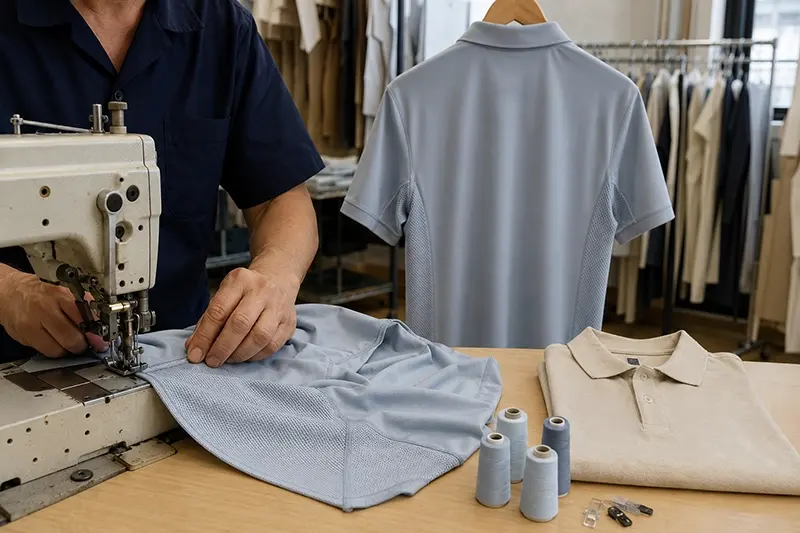
Is 100% Cotton Suitable for Golf Polos?
Cotton is breathable, soft, and comfortable for casual use. It also creates the traditional appearance many established golf clubs and premium lifestyle brands prefer.
However, cotton absorbs moisture and dries more slowly than polyester. During long outdoor activities, the fabric may become heavier and remain damp.
A 100% cotton golf polo is most suitable for:
- Mild climates
- Casual golf collections
- Clubhouse clothing
- Heritage-inspired brands
- Low-intensity use
- Customers who prefer natural fibers
Cotton-spandex can improve flexibility while preserving a natural feel. It is a useful option for premium golf polos that prioritize appearance and comfort over maximum moisture management.
For hot climates or intensive activity, polyester-based fabric is generally more practical.
Smooth Jersey vs Textured Piqué
Golf polo fabrics can use smooth jersey or textured piqué structures.
Jersey has a flat surface and softer drape. It creates a lightweight, modern, and athletic appearance. It also provides a good base for printed graphics and technical detailing.
Piqué has a raised surface that gives the polo more structure. It creates a traditional appearance and can help the garment sit slightly away from the skin.
Choose jersey when you want:
- A modern sportswear look
- Smooth surface printing
- Lightweight drape
- Soft movement
Choose piqué when you want:
- Recognizable polo texture
- More structure
- A professional appearance
- Classic club styling
The fiber composition and finish may have more impact on performance than the knit structure alone. Buyers should evaluate the complete fabric rather than assuming all jersey or piqué materials behave the same way.
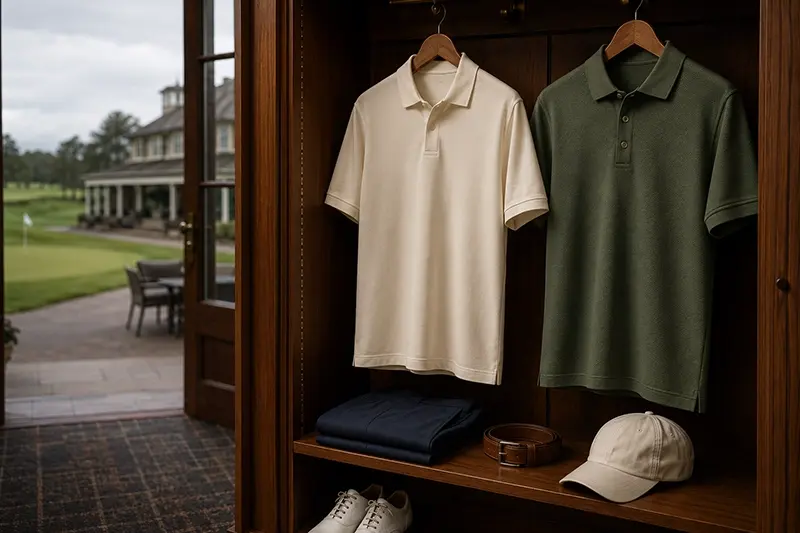
What GSM Is Best for Golf Polo Shirts?
For many golf polos, approximately 160–200 GSM provides a useful balance between comfort, coverage, and movement. However, the best weight depends on the composition, knit structure, color, and climate.
Lighter fabrics are suitable for heat and high activity, but they should be checked for transparency and durability. Light colors often need better opacity than dark colors.
Medium-weight fabrics provide more structure and may support embroidery more effectively. They are suitable for club uniforms, retail collections, and corporate golf programs that need a professional appearance.
GSM does not directly measure breathability or quality. A dense 170 GSM fabric may feel warmer than an open 190 GSM piqué. Yarn, knitting, and finishing also influence the result.
Through professional polo fabric selection, buyers can compare weight, airflow, stretch, opacity, and hand feel before choosing the material.
How Fabric Affects Fit and Movement
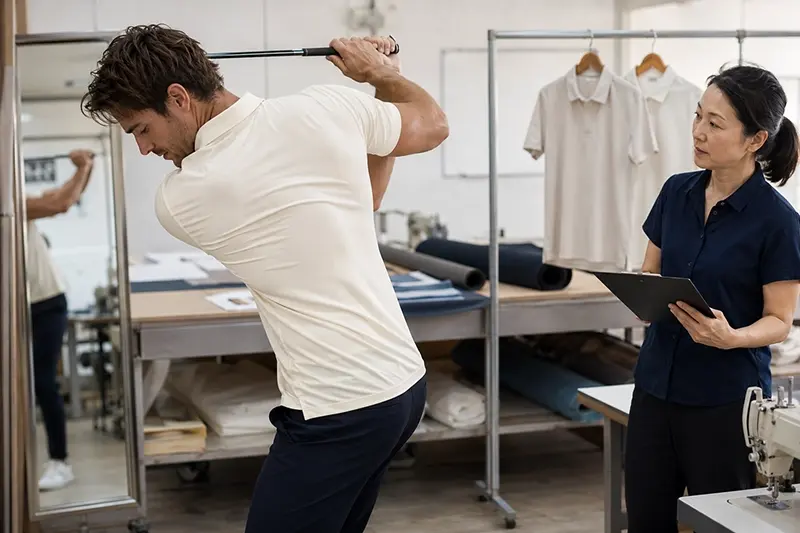
A golf polo must allow shoulder rotation and arm movement without pulling across the chest or lifting excessively at the hem.
Four-way stretch provides flexibility in multiple directions and is useful for athletic fits. Mechanical stretch may offer moderate flexibility without spandex, depending on the yarn and knit structure.
The pattern should include:
- Balanced shoulder width
- Comfortable chest room
- Flexible armholes
- Suitable sleeve openings
- Enough upper-back movement
- Stable body length
Stretch cannot correct an unsuitable pattern. A polo can still feel restrictive if the shoulder, chest, or armhole is too narrow.
The fit sample should be tested during a simulated golf swing, reaching, and rotation rather than only while the model stands still.
Logo and Printing Compatibility
Embroidery is widely used for golf polos because it provides a professional appearance for club crests, sponsor logos, and brand marks.
Lightweight stretch fabrics require careful control. Dense embroidery can restrict the fabric or cause puckering. Smaller logos, lighter stitch density, suitable backing, and correct thread tension usually produce a better result.
Other options include:
- Screen printing
- DTF printing
- Heat transfer
- Silicone logos
- Patches
- Sublimation
Sublimation is suitable for compatible polyester fabric and works well for gradients, all-over graphics, sponsor designs, and team patterns. The design becomes part of the fabric, so it does not create a heavy surface layer.
Through embroidery and printing development, the logo should be tested on the actual fabric before approving bulk production.
Additional Performance Features
Some golf polo projects may require additional fabric functions, such as:
- UV protection
- Anti-odor treatment
- Cooling finishes
- Anti-static properties
- Water or stain resistance
- Recycled polyester content
These features should only be specified when the target market needs them. Each function may affect cost, MOQ, fabric availability, care instructions, and testing requirements.
Buyers should request supporting test information when making measurable performance claims. A standard polyester polo should not be marketed with a specific UV rating or other technical claim unless the fabric has been tested accordingly.
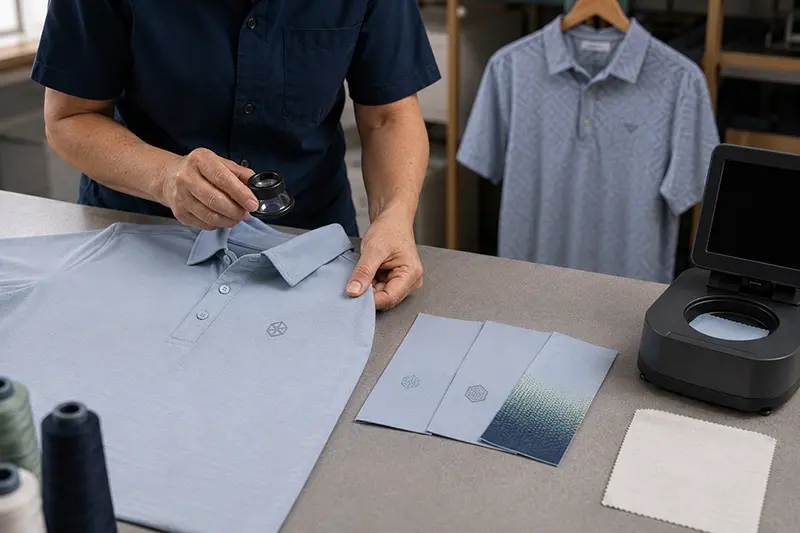
What Should Buyers Check Before Approval?
Before approving a golf polo fabric, evaluate:
- Hand feel
- Breathability
- Moisture management
- Drying speed
- Stretch and recovery
- Opacity
- Snag and pilling resistance
- Color fastness
- Shrinkage
- Logo compatibility
A fabric swatch helps with initial selection, but a complete polo sample is necessary to evaluate movement, collar balance, drape, and logo appearance.
Our standard MOQ is 100 pieces per design per color, with mixed sizes available. Sampling normally takes 10–15 working days, while bulk production generally takes 25–30 working days after approval.
Which Golf Polo Fabric Should You Choose?
Choose polyester-spandex for the best overall balance of movement and performance. Select polyester piqué for a more traditional polo appearance, or a cotton blend when natural comfort and smart-casual styling are more important.
The right fabric should match the climate, activity, branding, and target price. To compare golf polo materials or request a sample quotation, contact us with your fabric requirements, colors, quantity, logo, and reference images.
FAQs
Is mercerized cotton a type of piqué?
Not necessarily. Mercerization is a cotton treatment, while piqué is a knit structure. Cotton can therefore be both mercerized and knitted into piqué.
Does mercerized cotton feel softer than regular piqué?
It usually has a smoother surface, but softness also depends on cotton quality, yarn, knitting, GSM, and finishing.
Is mercerized cotton suitable for corporate uniforms?Is mercerized cotton suitable for corporate uniforms?
Yes, especially for executive, luxury hospitality, and premium customer-facing programs. Regular piqué may be more practical for general daily uniforms.
Can mercerized cotton be embroidered?
Yes. Its smooth surface can support clean embroidery, but logo size, stitch density, backing, and fabric stability should still be tested.
Is mercerized cotton worth the higher cost?
It is worthwhile when richer color, smoother feel, and premium appearance support the product’s market position and selling price.
Share With
Related Articles
Hot Products